
Cashier System in Malaysia: How to Run Promotions and Discounts Without Losing Margin
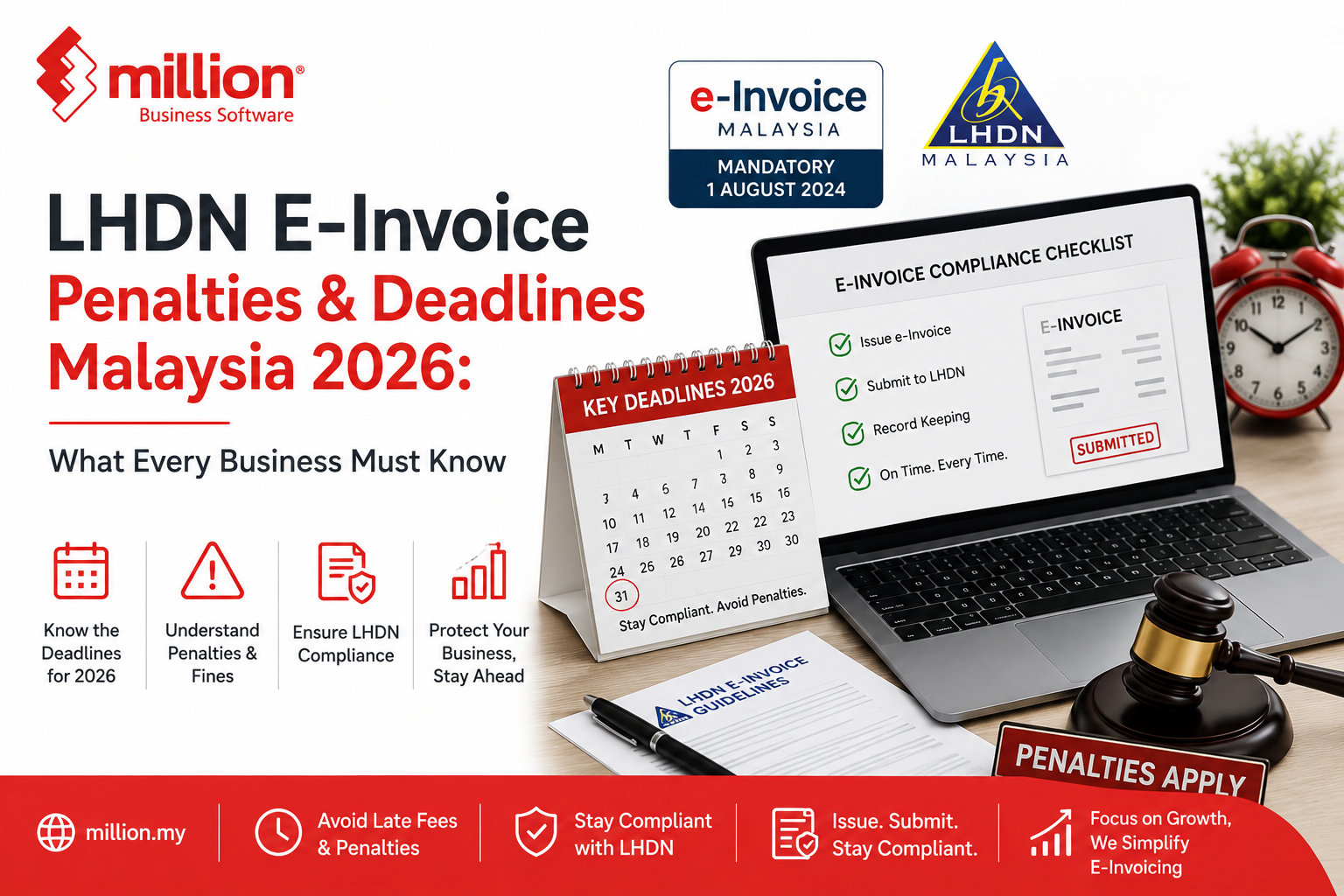
By now, most Malaysian business owners know e-invoicing is mandatory. What’s less clear to many is exactly when their business needs to comply, what counts as non-compliance, and how much it can actually cost if you get it wrong. With Phase 4 of the rollout affecting businesses with annual turnover between RM1 million and RM5 million from 1 January 2026, this is the year a lot more SMEs move from ‘watching from the sidelines’ to ‘must comply now.’
This article lays out the current deadlines, the RM10,000 individual e-invoice rule, and the penalty framework under the Income Tax Act 1967 — so you know exactly where your business stands.
Where Malaysia’s E-Invoice Rollout Stands in 2026
Malaysia’s mandatory e-Invoice system has been rolling out in phases tied to annual turnover, based on the taxpayer’s audited financial statements (generally Year of Assessment 2022, or the first available year for newer businesses). Businesses with annual turnover or revenue between RM1 million and RM5 million are required to comply from 1 January 2026, under what is commonly referred to as Phase 4 of the rollout. LHDN has also provided a relaxation period extending to 31 December 2026 for businesses in this bracket, giving some breathing room to get systems and processes in place without immediate penalty exposure — but the underlying obligation to issue and validate e-Invoices still applies from the start date.
Businesses below the RM1 million threshold currently fall under the exemption bracket, though this threshold has moved before and should be checked against LHDN’s current guidance rather than assumed to be fixed.
The RM10,000 Rule
One of the more practical changes for 2026 is the RM10,000 individual e-Invoice rule: transactions above RM10,000 in value require an individual, validated e-Invoice — consolidated e-Invoices are no longer permitted for these higher-value transactions. For business-to-consumer (B2C) sales below this threshold where the buyer doesn’t request an individual e-Invoice, businesses can still issue a normal receipt at the point of sale and submit a single consolidated e-Invoice summarising those transactions to MyInvois, typically by the 7th of the following month.
What Counts as Non-Compliance
- Failing to issue a validated e-Invoice for an in-scope transaction
- Failing to issue an individual e-Invoice for transactions above the RM10,000 threshold where required
- Missing the consolidated e-Invoice submission deadline for eligible B2C transactions
- Failing to issue a self-billed e-Invoice where one is required (see our related guide on self-billed e-Invoices)
- Submitting e-Invoices with incomplete or inaccurate mandatory data fields
Penalties for Non-Compliance
Under Section 82C of the Income Tax Act 1967, penalties for e-Invoice non-compliance in Malaysia can run from RM200 up to RM20,000 per non-compliant invoice, with the possibility of imprisonment for up to six months in more serious cases. Because penalties are typically assessed per invoice rather than as a single flat fine, the exposure for a business issuing hundreds or thousands of invoices a month without proper compliance can escalate quickly — this is one of the reasons LHDN’s relaxation periods for each phase matter: they give businesses a window to get their systems right before the stricter enforcement position applies.
The 72-Hour Cancellation Window
Once an e-Invoice is validated by LHDN through MyInvois, it can only be cancelled within 72 hours of validation. After that window closes, corrections must be made using a Credit Note, Debit Note, or Refund Note e-Invoice rather than a straight cancellation. This makes it important to check invoice details before submission, since fixing mistakes after the 72-hour window means additional documentation rather than a simple edit.
How to Submit E-Invoices
- MyInvois Portal — LHDN’s free web-based portal for manual entry, suitable for lower invoice volumes
- API integration — direct connection between your accounting/ERP system and MyInvois, suited to higher transaction volumes
- Accounting software with built-in MyInvois submission — the practical middle ground for most SMEs, avoiding manual data entry while not requiring a custom API build
How Million Software Helps
Million’s accounting and invoicing software is built to help Malaysian SMEs manage compliance obligations like e-Invoicing alongside day-to-day bookkeeping, rather than treating them as a separate, bolt-on system. Because sales data across Million’s accounting, POS, and stock control products already flows into one system, e-Invoice compliance sits on top of records you’re already keeping — reducing the manual re-entry that tends to be where compliance errors creep in.
Frequently Asked Questions
When does my business need to start e-Invoicing in 2026?
If your annual turnover is between RM1 million and RM5 million, Phase 4 requires compliance from 1 January 2026, with a relaxation period running to 31 December 2026. Always confirm your specific threshold and start date against LHDN’s current Specific Guideline, as thresholds have been adjusted before.
What is the penalty for not issuing an e-Invoice in Malaysia?
Under Section 82C of the Income Tax Act 1967, penalties can range from RM200 to RM20,000 per non-compliant invoice, with possible imprisonment of up to six months in serious cases.
What is the RM10,000 e-Invoice rule?
Transactions above RM10,000 require an individual, validated e-Invoice rather than a consolidated one. Consolidated e-Invoices remain permitted only for smaller B2C transactions where the buyer does not request an individual invoice.
Can I cancel an e-Invoice after it’s been validated?
Yes, but only within 72 hours of validation. After that window, corrections must be made through a Credit Note, Debit Note, or Refund Note e-Invoice instead of a direct cancellation.
Conclusion
E-Invoice compliance in Malaysia isn’t a one-time setup — it’s an ongoing operational requirement with real financial exposure if it’s mishandled. Knowing your phase deadline, understanding the RM10,000 rule, and having a system that submits correctly the first time (rather than relying on manual portal entry for every transaction) is the difference between e-Invoicing being a minor process change and becoming a recurring compliance headache. Talk to Million Software about how our accounting and invoicing system supports MyInvois-compliant e-Invoicing for your business.

Related posts


