
Cashier System in Malaysia: How to Run Promotions and Discounts Without Losing Margin
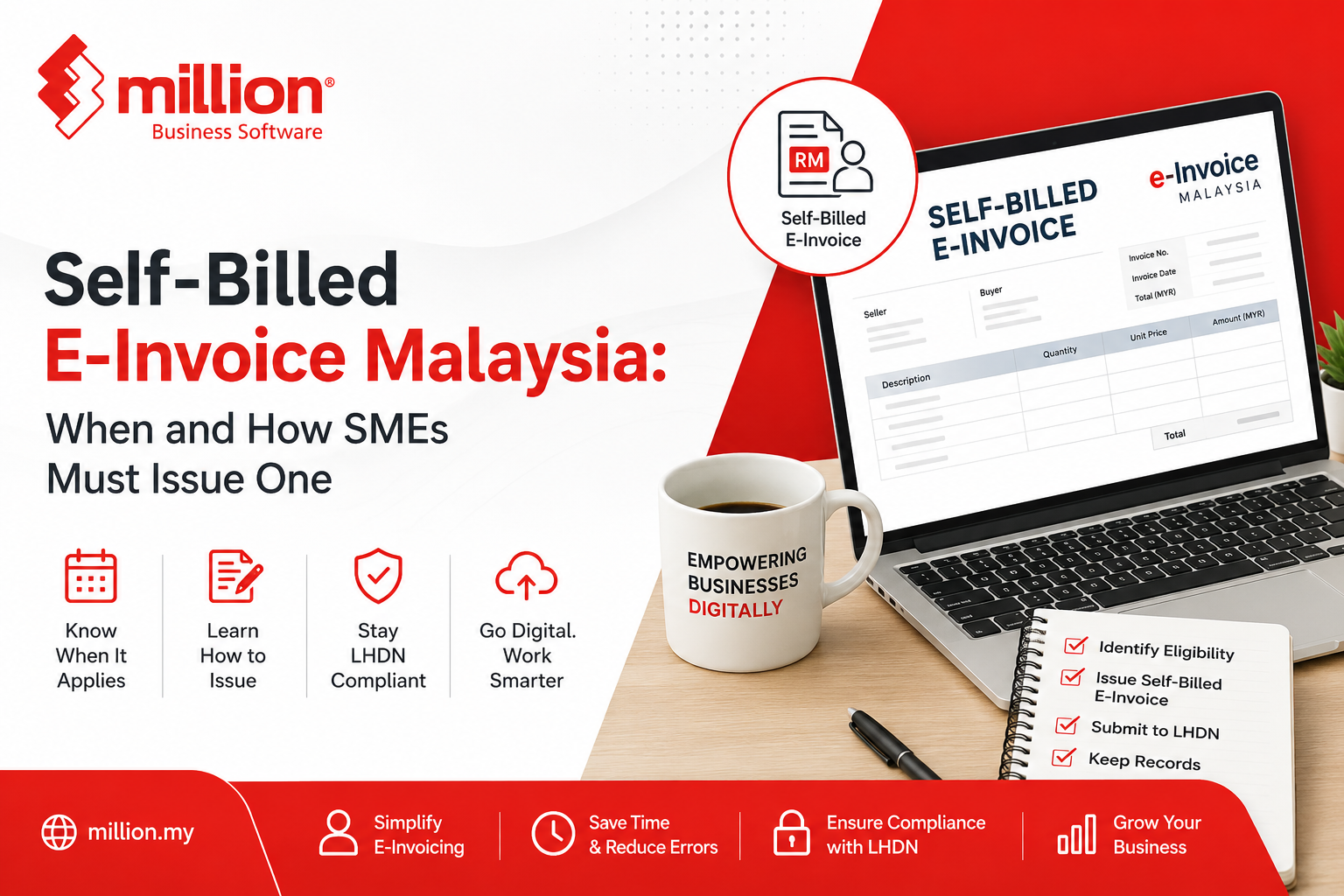
Most e-Invoice guidance assumes the standard direction: your business sells something, you issue the invoice. But Malaysia’s e-Invoice framework includes a reversed scenario that trips up a lot of SMEs — the self-billed e-Invoice, where the buyer, not the supplier, creates and submits the invoice. If your business pays commissions to agents or distributors, buys from overseas suppliers who don’t use MyInvois, or makes certain profit distributions, you may already be in a situation where self-billing applies without realising it.
What Is a Self-Billed E-Invoice?
A self-billed e-Invoice is an electronic invoice generated and submitted by the buyer, rather than the supplier, to document a transaction under LHDN’s e-Invoice Guidelines. It exists to cover situations where the supplier cannot or is not required to issue an e-Invoice themselves — most commonly because they’re a foreign entity outside Malaysia’s MyInvois system, or because of the nature of the payment (such as a commission or distribution) rather than a standard sale.
When Is a Self-Billed E-Invoice Required?
LHDN’s e-Invoice Specific Guideline sets out a defined list of scenarios where self-billing applies. You do not need to self-bill simply because a supplier is slow or forgets to issue an invoice — self-billing only applies to the prescribed categories. The most common scenarios for Malaysian SMEs include:
- Payments to agents, dealers, or distributors — commissions or fees paid on a recurring basis (common in insurance, direct selling, automotive distribution, and property agency businesses)
- Purchases from a foreign supplier who does not use Malaysia’s MyInvois system — for example, buying software, consulting services, or equipment from an overseas vendor
- Certain profit distributions to recipients
- Payments to individuals or parties who do not themselves issue e-Invoices
- Payouts by licensed betting and gaming operators to winners
What If the Supplier Can Issue a Valid Invoice?
If your supplier is able to issue a validated e-Invoice through MyInvois, you should use that document rather than creating a duplicate self-billed record. Self-billing exists specifically for cases where the supplier cannot or is not required to participate in MyInvois — it’s not an alternative process to use whenever convenient.
What Information Do You Need to Prepare?
- Supplier’s (payee’s) legal name, address, and tax identification details where available
- For foreign suppliers without a Malaysian Tax Identification Number (TIN), the placeholder TIN EI00000000010 is used
- Full transaction details — description, quantity, unit price, applicable tax, and total amount
- Buyer’s details, since the buyer is acting as the invoice issuer in this scenario
The Submission Process
Issuing a self-billed e-Invoice follows the same core process as a normal e-Invoice, with the buyer taking on the supplier’s usual role: the buyer submits the transaction details to LHDN via the MyInvois Portal or API, LHDN validates the submission and returns a Unique Identification Number and QR code, and both parties (where applicable) are notified of the validated document. If MyInvois rejects a submission, review the error, correct the affected fields, and resubmit — a rejected document is not considered compliant until it passes validation.
What’s Exempt From Self-Billing
Certain payment types are excluded from the self-billed e-Invoice requirement, including employment income, pensions, alimony, zakat, and certain dividend distributions, along with other categories LHDN specifically exempts. If a transaction doesn’t fall within one of the prescribed self-billing categories, the standard e-Invoice process applies instead — or no e-Invoice obligation exists at all, depending on the nature of the payment.
Why This Matters for Malaysian SMEs
Self-billing is easy to overlook because it inverts the usual invoicing workflow — most accounting teams are set up to issue invoices for sales, not for purchases. Businesses that regularly pay overseas vendors, run agent or distributor networks, or handle profit-sharing arrangements should map which of their recurring payment types trigger a self-billing obligation, rather than discovering the requirement transaction by transaction. Building this into your accounting workflow — so the system flags a self-billing scenario automatically rather than relying on staff to recognise it — is the more reliable long-term approach.
Frequently Asked Questions
What is a self-billed e-invoice?
It’s an e-Invoice created and submitted by the buyer instead of the supplier, used when the supplier cannot or is not required to issue one through MyInvois — for example, foreign suppliers or agent commission payments.
Do I need to self-bill every time a supplier is late issuing an invoice?
No. Self-billing only applies to the specific categories set out in LHDN’s e-Invoice Specific Guideline, such as foreign suppliers, agent/distributor commissions, and certain profit distributions — not simply because a supplier delays invoicing.
What TIN do I use for a foreign supplier without a Malaysian tax number?
LHDN’s rules allow the placeholder TIN EI00000000010 for foreign suppliers who do not have a Malaysian Tax Identification Number.
Is a self-billed e-invoice validated the same way as a normal one?
Yes — self-billed e-Invoices go through the same MyInvois validation, receive the same Unique Identification Number and QR code, and follow the same mandatory data field requirements as standard e-Invoices.
Conclusion
Self-billed e-Invoicing is one of the more misunderstood corners of Malaysia’s e-Invoice framework, precisely because it asks businesses to document purchases rather than sales. For SMEs that regularly deal with overseas suppliers, agent networks, or distribution commissions, getting familiar with the prescribed categories now avoids gaps in your compliance records later. Million Software’s accounting and invoicing tools are built to help Malaysian SMEs manage the full range of MyInvois obligations, including self-billed scenarios, without adding a separate manual process on top of your existing bookkeeping.

Related posts


