
Credit Note, Debit Note and Refund Note in MyInvois: How to Correct a Validated E-Invoice
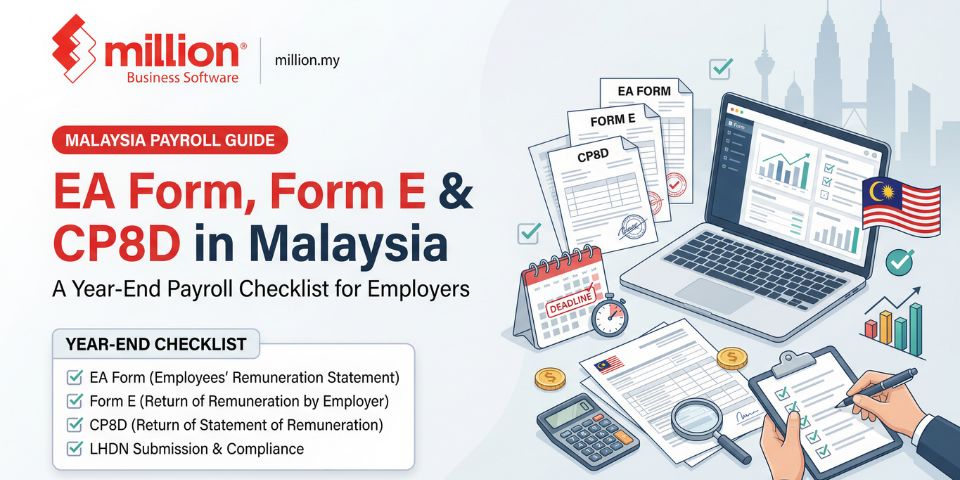
Quick answer: Employers give each employee an EA Form (C.P.8A) by 28 February, then submit Form E with the CP8D data file to LHDN by 31 March through MyTax. For income earned in 2026, that points to 28 February 2027 and 31 March 2027, so start reconciling payroll in December. Dates follow an annual pattern, so confirm them on LHDN’s site each year.
Every February, HR and finance teams in Malaysia scramble to produce year-end tax documents. Most of the stress is avoidable. If your payroll records are reconciled early, the forms are mostly a matter of exporting the right data. Here is what each document is and how to prepare.
What are the EA Form, Form E and CP8D?
| Document | Who prepares it | Who receives it | Purpose |
|---|---|---|---|
| EA Form (C.P.8A) | Employer | Each employee | Summarises the employee’s annual remuneration and deductions |
| Form E | Employer | LHDN | Employer’s annual return declaring employees and total remuneration |
| CP8D | Employer | LHDN | Data file listing each employee’s income, submitted with Form E |
Employees use the EA Form to complete their own personal income tax return (Form BE), with deadlines in April and May.
What are the deadlines?
| Task | Deadline pattern | For income earned in 2026 |
|---|---|---|
| Issue EA Forms to employees | By 28 February | 28 February 2027 |
| Submit Form E and CP8D to LHDN | By 31 March (some sources note a later e-filing date, so verify on MyTax) | 31 March 2027 |
These dates are based on the pattern of recent years. LHDN can change them, so confirm before you plan.
Who must receive an EA Form?
In general, every employee who received remuneration from you during the year, including staff who resigned before year end. Guidance varies on minimum employment periods, so check LHDN’s employer guide for the exact rule. Forgetting resigned or terminated employees is one of the most common mistakes.
Year-end payroll checklist (December to February)
- Reconcile monthly payroll against the totals you submitted for EPF, SOCSO and PCB. See EPF, SOCSO and PCB calculation.
- Check employee master data: names, ID or passport numbers and tax numbers.
- Review variable pay: bonuses, commissions, allowances, claims and benefits-in-kind.
- List leavers and joiners so no one is missed.
- Lock the payroll year once figures are final.
- Generate EA Forms from verified payroll data and spot-check a sample.
- Distribute them on time and keep proof of delivery.
- Prepare Form E and the CP8D file and submit through MyTax.
Which errors cause problems?
- Missing the 28 February distribution deadline.
- Leaving out resigned or terminated employees.
- Using an outdated template.
- Figures that do not match PCB and EPF records already submitted.
- Spreadsheet formula mistakes in manual payroll.
- Late or incorrect submissions can attract penalties under the Income Tax Act, so check LHDN for the current position.
Should you use payroll software for EA and CP8D?
- Yes, if it can pull from a single verified payroll record. Look for software that:
- Stores a full-year history for every employee, including leavers.
- Produces EA Forms and the CP8D file in LHDN’s required format.
- Keeps statutory contributions and PCB aligned with the figures on the form.
- Tracks leave, claims and allowances so variable pay is complete. See our e-leave system guide.
- Compare options in our best payroll software guide and the payroll for small business guide.
Frequently Asked Questions
What is the deadline for the EA Form in Malaysia?
Employers must issue the EA Form to each employee by 28 February following the income year.
What is the difference between EA Form, Form E and CP8D?
The EA Form goes to the employee. Form E is the employer’s annual return to LHDN. CP8D is the data file of employee income submitted with Form E.
Do I still need to file Form E if I have no employees?
Some guidance says Form E may still be required with a declaration of no employees, while the CP8D file may not apply. Check LHDN’s employer guidance for your business type.
Make year-end payroll painless
Million Payroll helps Malaysian businesses manage payroll and statutory deductions in one place. Book a demo and ask to see the year-end process.

Related posts


